Where Meaning Begins: Simona Ray on Myth, Memory, and the Inner Life
Dive into the world of Simona Ray, where myth and memory intertwine. Discover Simona Ray's unique approach to art and the inner life.
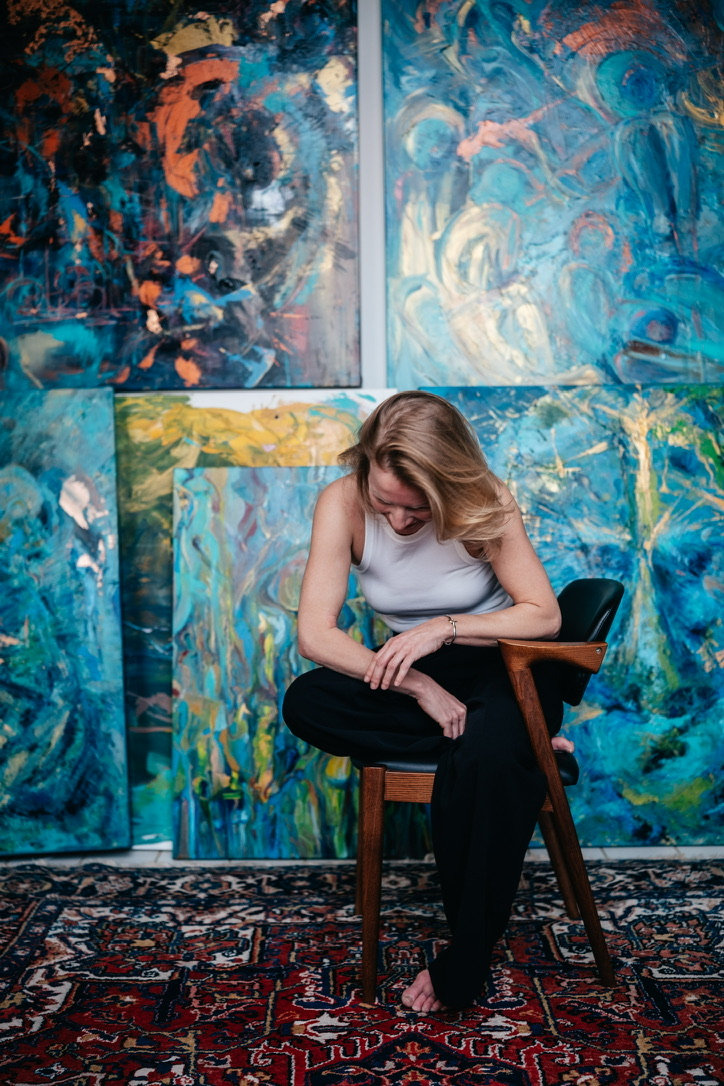
Some artists explain their work. Others let you sit with it.
Simona Ray does neither. She pulls you into it.
Her paintings and poems don’t start with clarity. They start with something harder to hold. A feeling you recognise before you can name it. The kind that sits just under the surface and waits for a moment of stillness to rise.
This is the first conversation in a new series with Ray, and it begins at the core of everything she creates. Myth, memory, and the inner life. Not as distant ideas, but as something immediate. Lived. Felt in real time.
Speaking around her presentation at the Women In Louvre II in Paris, she doesn’t position herself as someone constructing meaning. She follows it. Lets it arrive. Lets it take shape before she fully understands it herself.
What unfolds is not just an insight into her work, but into the emotional landscape that sits beneath it. The part most people move past too quickly.
Your work often draws on mythological and archetypal imagery. What draws you to these ancient stories when you're trying to express very modern emotions?
I have to begin with where I live. The word Praha — Prague — means threshold. The city itself is named for a portal. Angelo Maria Ripellino, in his famous book Magic Prague, described this city as a place of mystery and hidden fascination, animated by what Gustav Meyrink called an invisible magnetic current. Rudolf II turned Prague into the centre of alchemy and the occult arts, gathering Tycho Brahe, Johannes Kepler and John Dee under one roof. The Golem was shaped from the clay of the Vltava riverbank, right here, and brought to life through incantation. Kafka lived at Golden Lane beneath the castle and could not escape its atmosphere. I grew up in all of this. The ancient and the present are not separate here. They occupy the same breath.
So when mythological figures begin arriving in my work, I am not reaching backwards. I am simply responding to the atmosphere I have always lived inside. I did not choose to paint goddesses. The first goddess who came was Lethe — the river of forgetting — in my Core Trilogy, Journey of Acceptance. I was responding to something I felt urgently, something I could not name yet, and she arrived as the only accurate image for it. That is how all the goddesses have come: Tyche, Ananke, then later Theia, Aphrodite, Sophrosyne, Persephone, Euphrosyne. Each one arrived before I understood why. I never planned a series about Greek mythology. I followed what arrived.
What myth offers that modern language cannot is the full texture of human experience — not the rational surface, but the shadow, the descent, the transformation. When I say I am struggling, or I am healing, those words are thin. They describe a state without giving you its weight, its particular quality, its exact colour. But Lethe, offering forgetting as mercy rather than failure, gives you something you can inhabit with your whole body. Myth is not nostalgia. It is precision. And in a city like Prague, where alchemy — the art of transmuting base material into gold — is woven into the very stones, precision through symbol feels not like a choice but like home.
Do you see myth as a form of emotional language — a way of speaking about pain, transformation, and identity when ordinary words fall short?
Completely. And I want to be precise about this, because it is easy to misunderstand. I am not using mythology as cultural decoration, or reference, or tribute to the ancient world. I am using it the way you use language — not to display knowledge of the word, but because it is the only exact word available. That is what I am doing with paint and myth.
My Core Trilogy — Journey of Acceptance — traces a movement from relief to regret to reckoning. Lethe is the grace of forgetting: the nervous system protecting itself before it is ready to see. Tyche is the grief of recognition — the moment you understand what you turned away from, what you missed while you were surviving. And Ananke is necessity — the moment truth arrives and will not be silenced. Her poem says it plainly: 'You do not want me, I am here / Screaming loud and crystal clear.' That is a state that millions of people know from the inside. But reaching it through the figure of Ananke — the Greek spirit of inevitability — means arriving without clinical distance. You feel it, not merely understand it.
The second series, Becoming One — Journey of Recognition, moves into the ascent. Theia reclaims her identity after centuries of being reduced to a label. Aphrodite claims sovereignty through creation, not seduction. Sophrosyne discovers that balance is wisdom earned from within, not obedience imposed from outside. Persephone reframes her descent as an act of agency. Euphrosyne arrives as joy that survived sorrow. Each is a psychological threshold dressed in the only language large enough to hold it. And alongside each painting, there is a poem — not written to explain the image, but received in the same state of deep listening. The painting and the poem are two voices of the same truth. One speaks what the other cannot say aloud.
Many of your paintings feel rooted in memory, even when they are abstract. How much of your own personal history finds its way into your work, consciously or unconsciously?
The most honest answer I can give is this: my psyche was painting my journey in real time, long before I consciously understood what I was processing. I have worked with a Jungian life coach for some time. I believe deeply in self-development and in the slow, careful work of undoing what is not truly us — of removing the layers that were placed on us by others and finding what was always beneath. And yet the paintings arrived before I understood any of this intellectually. I did not sit down to make a series about healing or transformation. I followed what arrived.
The figures from the Core Trilogy — Lethe, Tyche, Ananke — came through a period of my life I was not yet able to name directly. Only after completing that trilogy did I begin to see the shape of what I had been living. Only after completing both full series did I understand that together they map a complete process of Jungian individuation: descent into shadow, confrontation with necessity, and then the rebuilding of identity across five thresholds. The work knew the map before I did. I was the last to be told.
Alchemists believed in transmutation — that something base could be heated, worked, and transformed into something essential. That is the only way I know how to describe what happens to personal history in my process. It arrives not as autobiography but as raw material that the painting heats until something universal becomes possible. The particular grief of Tyche became the grief of unlived life that anyone can inhabit. The specific moment of Ananke — my own inner 'no more' — became a presence others recognise in themselves without knowing anything of my story. I believe we need to be authentic. To put down the mask about how we are really doing, about who we truly are. Falling is not failure. It is part of our Becoming.
This is also what I discover in my commission work. When I paint someone else's inner world, I am not making a likeness. I am listening for the thing that has always been there, the beauty and strength the person carries without always recognising it. The same mechanism is at work: the personal and the universal are never opposites. The most particular moment, held with enough honesty and patience, becomes the moment everyone shares. That is what I reach for in every painting.
When you work with archetypes and symbolic figures, are you telling your story, the viewer's story, or something that exists between the two?
Neither and both. And I want to say this carefully, because it is not modesty — it is the actual mechanism of the work. I do not consciously paint my journey. I stand before a blank canvas with a blank mind. And then it begins to speak, and to lead my hand. I find myself going to the kitchen in search of a pack of sponges. I am led to the roof to spray colours at the least convenient moment. I try to concentrate, and a poem falls fully formed into my head and I must stop and write it down before it is gone. The thinking mind is not in charge. Something else arrives and I follow.
And yet my descent is real. My forgetting was real. My grief and my reckoning and my slow rebuilding — those are mine. They are the raw material through which the archetypes move. But archetypes do not belong to individuals. They belong to the structure of human experience itself. When I paint Theia asking who am I, when I am no longer what others needed me to be — that question is mine. And it belongs to everyone who has ever lost themselves in someone else's definition of who they should be.
My SEE YOU performance in Times Square was built on exactly this principle. I placed myself — still, present, unmoving — inside one of the most overstimulating environments in the world and held one question for twenty-four hours: Do we truly see each other, or do we only look? The performance worked not because it told my story, but because it created a surface in which others could encounter their own. Standing still in a place built entirely for movement and spectacle — that between-space, between my presence and the viewer's recognition, is where the work lives. Every painting works the same way. I am always the first viewer. But I am never the only subject.
When someone stands before Persephone and says: that is me — they are not speaking about my descent. They are standing inside their own. The painting became the threshold. Which brings us back to Prague. PRAHA means threshold. A portal. The work I make is not a destination. It is a passage point. You enter, you encounter something you recognise in yourself, and you leave changed in a way you may not yet be able to name. That is the space between my story and yours. That is where I am always trying to work.
Do you think people are drawn to myth today because we are searching for meaning in a world that often feels fragmented and unstable?
Yes — but I think it goes deeper than meaning, or even comfort. I think people are searching for permission. Permission to feel the full range of human experience, including the parts that contemporary culture asks us to optimise away. The shadow. The descent. The grief that has no resolution yet. The moment before you are ready to heal. Lethe exists in my work not as failure of memory but as grace — the capacity of the psyche to shield itself until it is strong enough to see. That is not a medieval idea. That is something happening in people's nervous systems right now, in this week, in every city in the world. But we have almost no public language for it.
This is where myth becomes irreplaceable. Ancient stories survived not because people carefully preserved them, but because they are made of the same material as human experience and they do not simplify that experience.
I also think people are exhausted by fragmentation — by the sense that there is no arc, no larger pattern, no way to understand their own experience as part of something coherent. What the Greek series offers, both the Trilogy and the five goddesses together, is exactly that: an arc. A true map of the interior journey. Down through forgetting and grief and reckoning, through the rebuilding of identity and desire and balance and agency, arriving finally at Euphrosyne — joy with depth, joy that remembers what it survived, joy that cannot be taken. That arc is ancient. And it is urgently needed now.
How do you balance emotional honesty with artistic distance, especially when you are working with themes that are deeply personal?
Alchemy is the right word for this, and not only because I live in a city built on it. The alchemical process is not simply about the destination — turning lead into gold. It is about the transformation that happens during the heating, the working, the patient attention to what the material itself requires. My process as a painter is exactly this. I do not sit down to confess. I sit down to respond — to what arrives through the brush, to what the colour demands, to the energy that moves through the canvas. The distance is not a shield I construct. It is built into intuitive painting itself. The image takes over. I follow.
The poems create a second kind of intimacy — and a second kind of distance. I write them while painting, or immediately after, in the same state of deep listening. They arrive as testimonies, not analyses. Meyrink described Prague as animated by an invisible magnetic current. That is exactly how it feels when the poems come — something passing through me and finding form. In that passing, the material stops being only mine. The poem is not about me. It is about the state. And the state, once named with enough precision, belongs to everyone who has ever lived it.
In my commission work I encounter this dynamic from the other side. When I paint someone else's inner world, I remain completely open — listening to what they carry, never imposing what I think I see. I bring my full sensitivity to the canvas, which means I am also moved, also present, also transforming the experience through my own perception. The balance is the same in both: full presence without appropriation. The painting passes through me, and in that passage, something true becomes visible that was not visible before. Clients sometimes tell me: it feels like you have known me for ten years. The poem feels like me, my journey. Or I will paint a silhouette of a family on horses, and then contact the client and say — horses must be important to you. And she tells me her partner loves horses, her daughter too, that her daughter is about to begin riding lessons. I did not know any of this. But the canvas did.
If your paintings were modern myths, what kind of lessons or truths do you hope they would leave behind?
That forgetting is not weakness. Lethe is not a failure — she is the psyche's wisdom before the psyche is ready to see. The nervous system that goes numb, that disconnects, that forgets in order to continue — that is intelligence, not cowardice. The first truth the work carries is that survival is not shameful. And when the time comes, as it does in Tyche and then Ananke, the truth arrives with its full weight. The grief is real. The reckoning is real. They are not skipped over. They are honoured. That is the second truth: you cannot reach Theia without first passing through Lethe.
That identity is multiple and vast. Theia refuses to be reduced to a single element. Her poem passes through water, air, fire, and earth — each a way others have labelled her, contained her, found her too much or too little. And she arrives at herself: not as any one element, but as woman. Not only one, but many. Sometimes confused, sometimes surprised by who she is becoming. In a culture that asks us to be consistent, legible, predictable, the truth that you cannot be reduced to one story is quietly radical.
Aphrodite discovered something beyond beauty: kindness. She feels sorrow. She wants to help so that others do not feel alone. Sophrosyne became such a strong person — doing what is right, holding others before herself, wanting to be good and contained — and yet she wonders why people cannot accept her for who she is, who she could be, who she is becoming. She feels lonely. But somewhere inside, she knows it will be all right. Persephone chose to descend. It is allowed to walk into our own shadow, to do things others do not understand or judge. It is difficult. But we must do what is right for ourselves.
And then Euphrosyne — the final painting, the close of the whole arc. She is joy that survived sorrow. Not happiness. Not the performance of positivity. Joy that holds the memory of what it cost. She remembers a time when she felt like less than ashes — invisible dust. And she arrived here anyway. The full journey of both series together — from Lethe's protective forgetting to Euphrosyne's hard-won light — traces the only path I know to genuine sovereignty. Down, then break, then clarity, then rebuilding, then choice, then joy.
The paintings carry that same impulse: they exist to make us see our uniqueness by showcasing the unusual and immortal, whilst offering people a surface in which they can see themselves clearly, and without shame. If gods could struggle, make mistakes, fall — why could not we? And they are still respected.
What truth I hope they leave behind, above all, is this: that your journey, exactly as it is, in whatever passage you are currently moving through, is not a mistake. You are not lost. You are on the map. And the map holds you. You are strong. You are loveable. You are unique and beautiful.
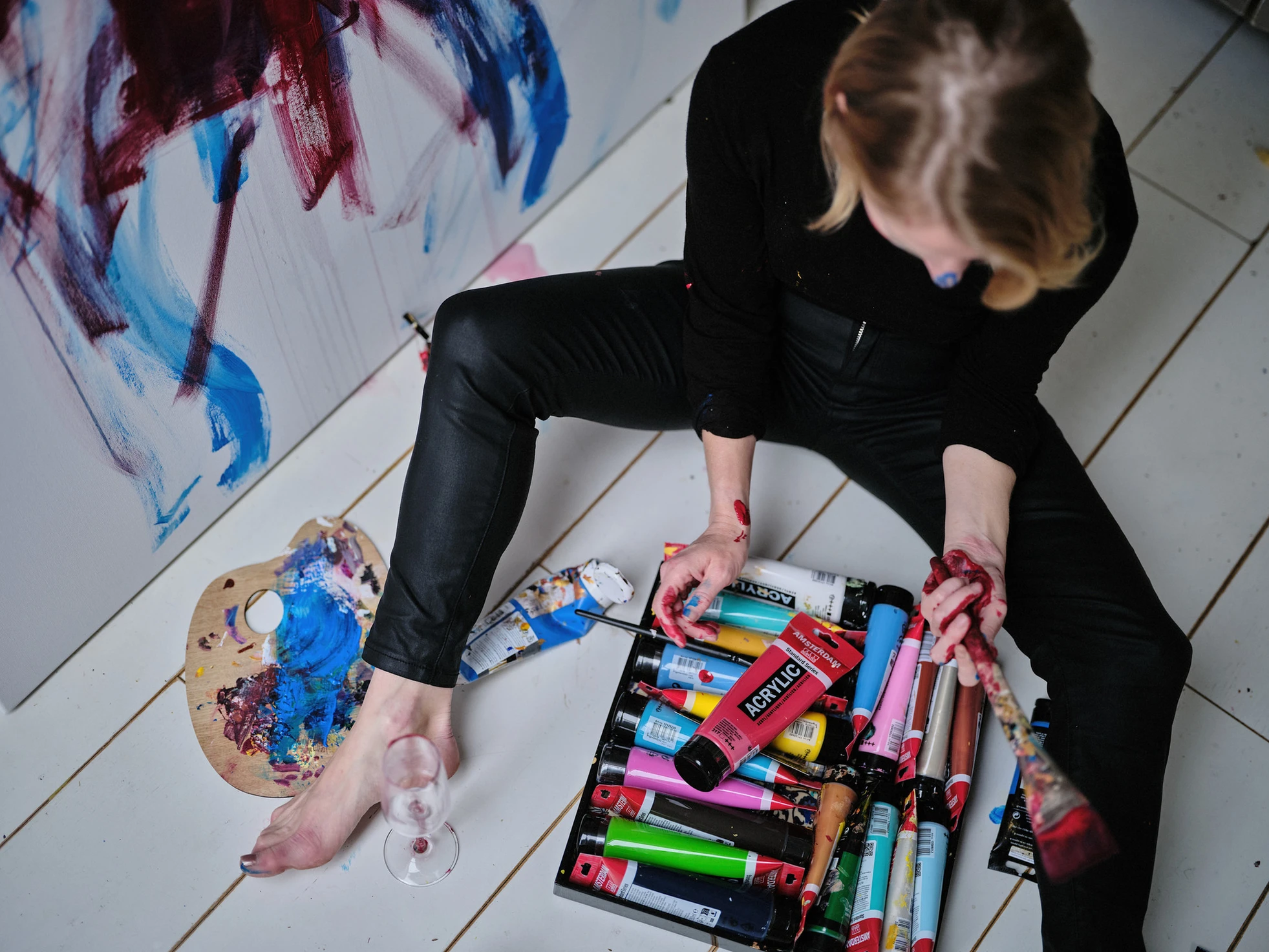
There is no attempt here to simplify anything. And that is exactly the point.
Simona Ray’s work sits inside the full weight of experience. The parts people tend to hide, rush, or reframe into something easier. Forgetting. Grief. The moment you realise something you cannot undo. The slow process of finding your way back to yourself.
She doesn’t treat those moments as problems. She treats them as necessary.
Myth becomes the language that holds it all together. Not as something decorative, but as something exact. A way of giving shape to experiences that don’t fit neatly into everyday words. It allows people to step into something and recognise themselves without needing it explained to them.
And that is where the work lands. Not in what is said, but in what is felt.
As the first part of this series, this conversation sets a clear tone. This is not about polished answers or finished versions of a person. It is about the process. The movement. The parts that are still unfolding.
And the understanding that none of it is wasted. Even the moments that feel unclear or unresolved.
Especially those.
Experience the journey
Would you like to walk the full arc of this series? The interactive experience is available at sentienttopaint.art/interactive-experience
The pentalogy Becoming One — Journey of Recognition will be exhibited at Art Shopping — Salon International d'Art Contemporain, Carrousel du Louvre, Paris, 10–12 April 2026, presented by Art Queens Gallery as part of Women of Louvre II. Euphrosyne is present physically. The remaining four goddesses — Theia, Aphrodite, Sophrosyne, Persephone — are present digitally, their stories visible to those who look.
Their story is unique. Same like yours.
Every each of us is a unique piece of canvas.
Continue Reading
More In Conversation With
Heidi Normanton on Building HeyLO!, Rejecting Diet Culture and Bringing Joy Back to Bread
Hiyäm Jabak on Presence, Discipline, and the Luxury of Slowing Down

Dr. Sima on Reclaiming the Female Body and Why Silence Was Never Neutral

Dr. Sima on Why Intimate Wellness Is Beauty’s Most Overlooked Frontier

Stories worth your
weekend.
A handpicked dispatch from Hinton's editors. The long reads, the people, the openings, the things worth knowing. No filler.