From Confrontation to Colour: The Evolving Language of Artist and Painter David Lendrum
Discover the vibrant journey of David Lendrum, an artist who evolved from confrontation to color. Explore David Lendrum's artistic transformation.
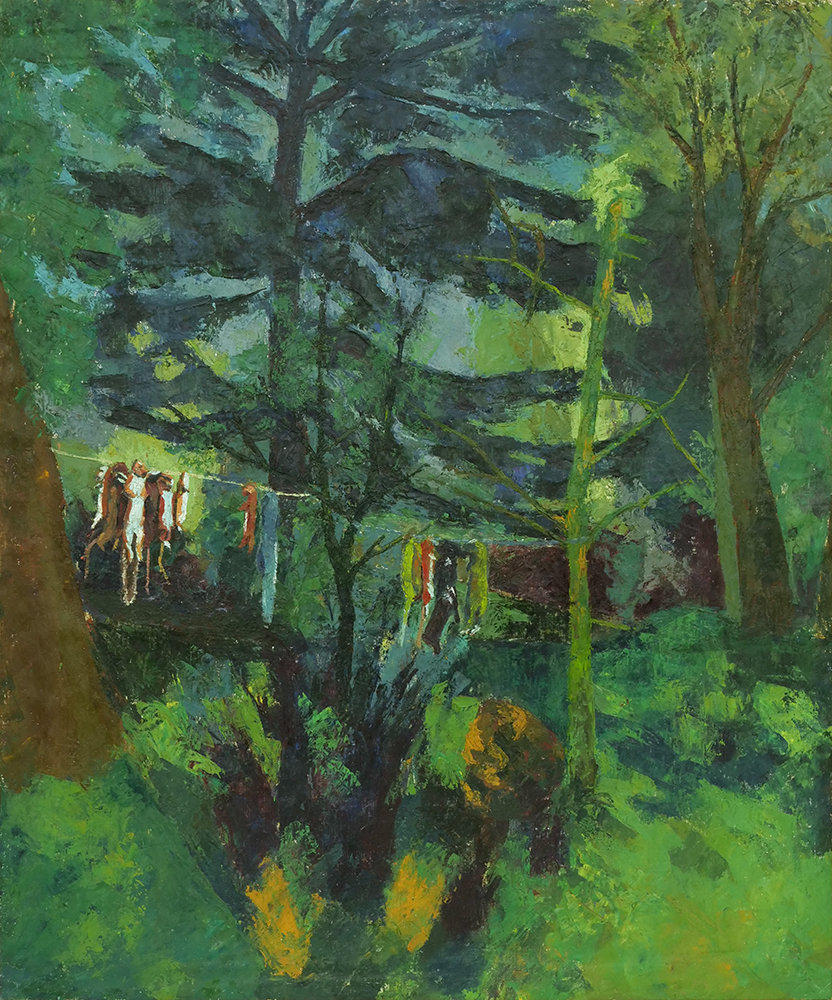
Few artists can trace their creative language back to a single defining moment, but for David Lendrum, that moment arrived as a young student in 1967. His painting Confrontation marked not only the birth of his artistic identity but also the start of a lifelong conversation between emotion, structure and truth. From the early defiance of his woodland scenes to the calculated balance of his abstract works, Lendrum’s story is one of continual reinvention.
Across this rare and reflective interview, the British artist recounts a journey that began among the flat fields of Cambridgeshire and moved through the intense conceptual rigour of Newcastle University and Saint Martin’s School of Art. What unfolds is a portrait of an artist who has never stood still — one who has built his career on questioning the relationship between feeling and form, instinct and intellect, light and matter.
Looking back to your earliest work, what was the very first piece you created where you felt, “This is me — this is my language”?
I was still at school (Felsted School, Essex, UK) when, in 1967, I produced the first painting which felt truly my own.
Titled Confrontation , it depicted a dense woodland view featuring a gamekeeper’s catch of slaughtered animals and birds hanging from a length of wire. My original intention was to render a pure landscape with the Cedar tree as the main subject, but after encountering this grisly scene when walking through a wood near my home in Cambridgeshire, I decided to insert it into my painting to express my anger at human cruelty towards animals.
I had already painted a number of landscapes in different styles (like Imaginary Landscape - View of Rabbity Place , 1966) and techniques, but Confrontation , with its rich textures, applied with a palette knife, and use of thick impasto oil paint, was more ambitious than anything I had attempted hitherto. It brought together influences from John Constable to Francis Bacon, in whom I was interested at the time, and was a summation of the techniques and ideas I had developed. It was also the largest painting I had attempted and was shown in an exhibition in London.
Your time at Newcastle clearly shaped your thinking — not just technically, but conceptually. How did that early academic experience push or challenge your natural instincts as an artist? – Why did you move into sculpture? What changed?
Studying on the B.A. Fine Art Course at Newcastle University was a sea change for me. In the first year, the Foundation Course was unlike anything I had encountered before because drawing and painting from life played a very minor role (a morning’s life drawing a week and some voluntary evening classes were all that was offered). Instead, we spent each week analysing different elements of visual language - line, tone, colour, texture etc. - in a series of exercises, creating tone scales, colour charts and so on. It was all very abstract. We were instructed to think like scientists; it was based on the teaching methodology of the famous Bauhaus art and design school, Germany, in the 1920s. It was a very rational, conceptual, approach to art, everything had to be intellectually justified.
At first, I felt resistant to this because I wanted to paint from life and learn how to improve my painting techniques, but as time went on, I became ‘converted’ to this approach because I began to think that abstraction was the only way forward if I wanted to do something new and different from the past. I started working with simple, flat geometric shapes which then evolved into reliefs, before becoming fully three-dimensional sculptures. At the time this seemed to me the logical way forward for artistic development.
The tactile, almost architectural quality of your work seems deeply rooted in those early installations. Were you always drawn to the physical presence of a piece, or did that evolve with the studio and gallery spaces you were working in?
When I was producing sculptures at Newcastle, I became interested in working in a large scale and yes, they were architectural in some ways. I never placed my sculptures on bases or plinths but they stood directly on the ground because I wanted them on the same scale as me and exist in the same reality, instead of being elevated by a plinth or pedestal to a different level and into its own world. One of the first sculptures I made comprised a curved, serpentine structure, made out of thin plywood. There were some open and enclosed spaces in it through which I could walk and it was about chest high. I wanted to integrate the sculpture with the space around it.
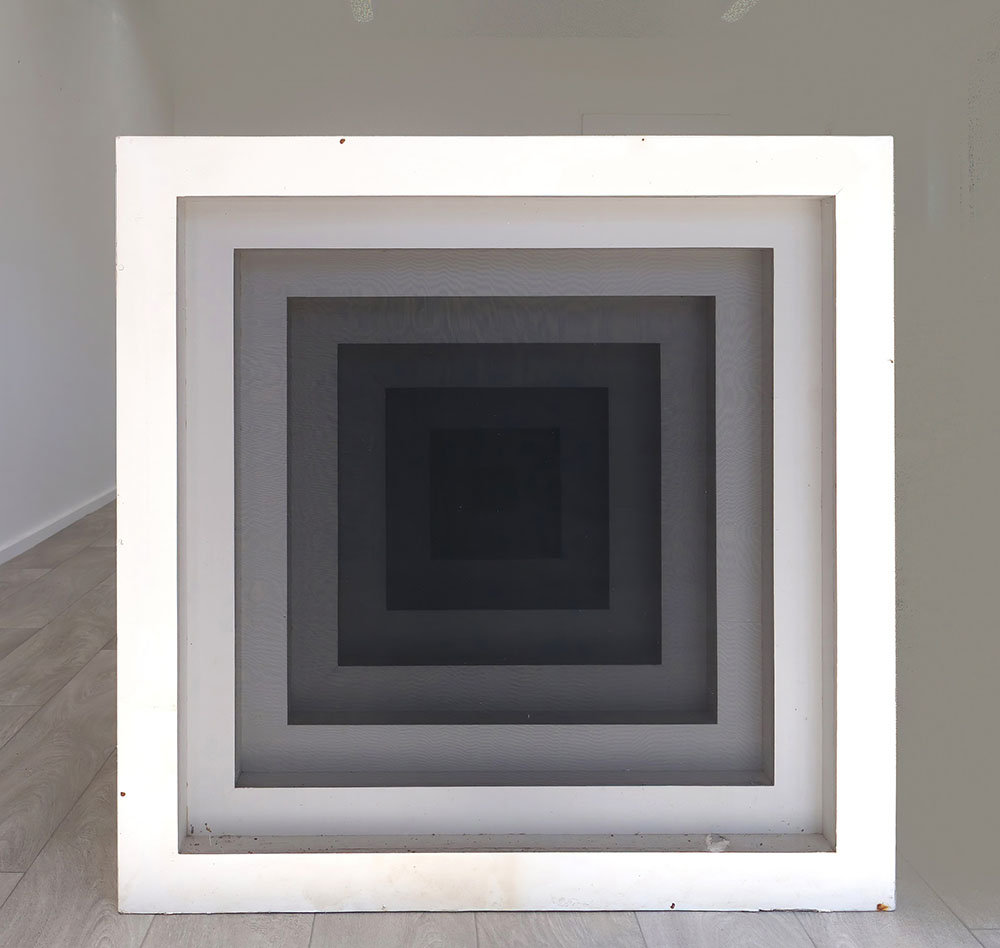
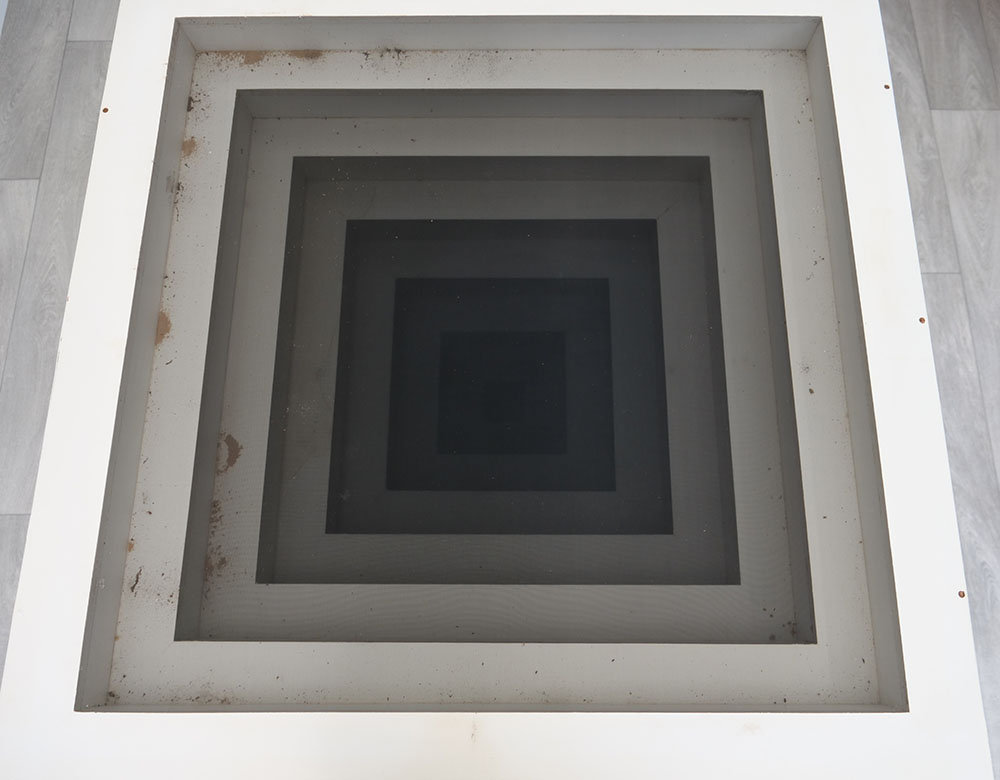
Left: Side view of Cube , 1970, White plywood frame with black chiffon sheets, 98 x 98 cm
Right: Top view of Cube , showing damage cause by wood-boring insects over time
My second sculpture was very different; it comprised a symmetrical, six-sided Cube , 1970, with each side, apart from the base, made up of seven transparent, thin layers of chiffon, stretched over plywood steps, which recede into the centre of the cube. When viewed from each side an illusion of a mysterious, deep black hole, where light does not penetrate, is created. The above photographs of Cube show two views; one from the side where you can see the tonal change caused by the overlapping seven layers of chiffon, and the other from the top side showing a similar effect. Unfortunately, during the fifty-five years since its manufacture, insects have found a way into the structure, hence the little piles of sawdust!
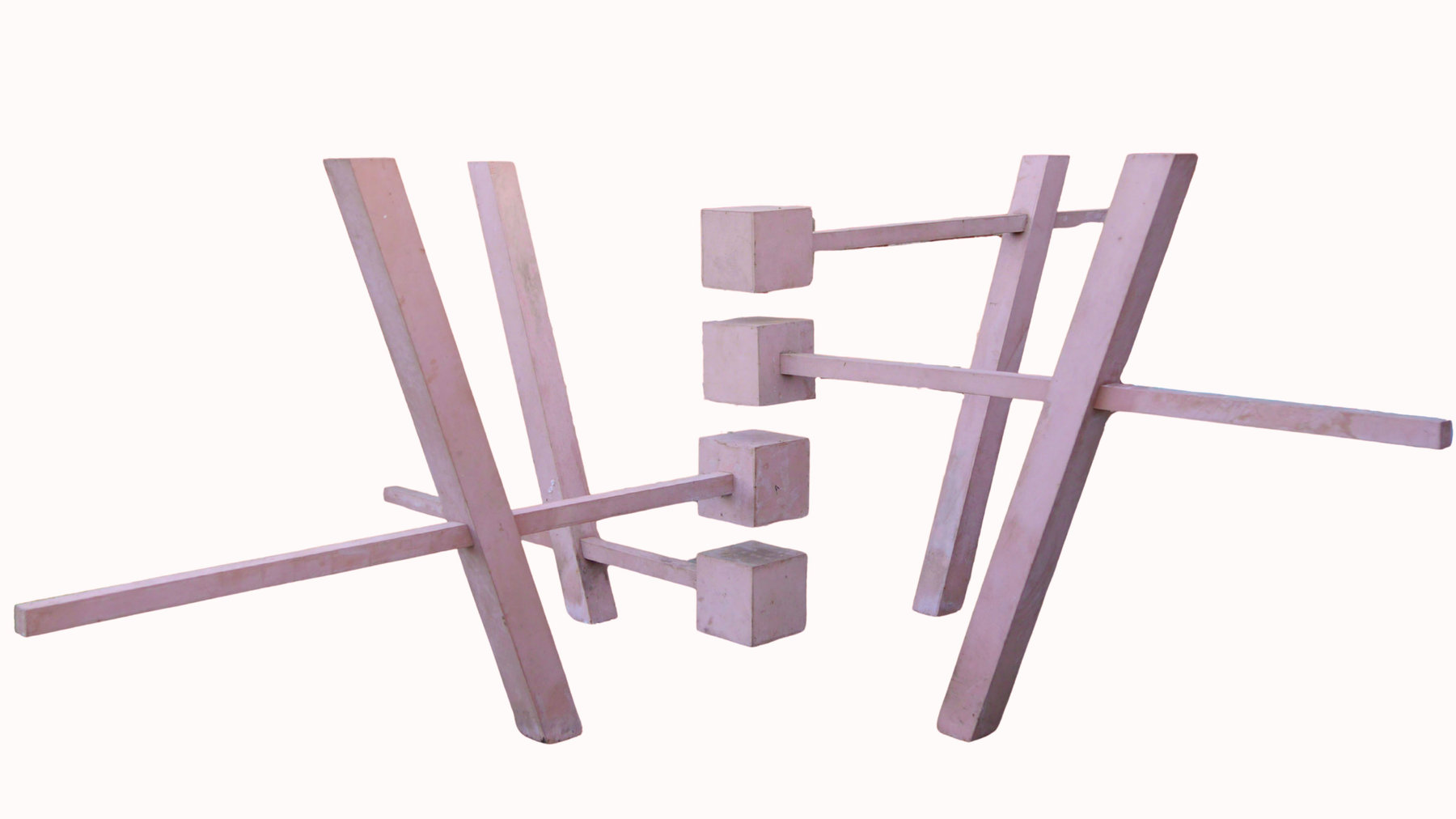
In the following year, 1971, I became fascinated with ideas about balance, systems and structures.
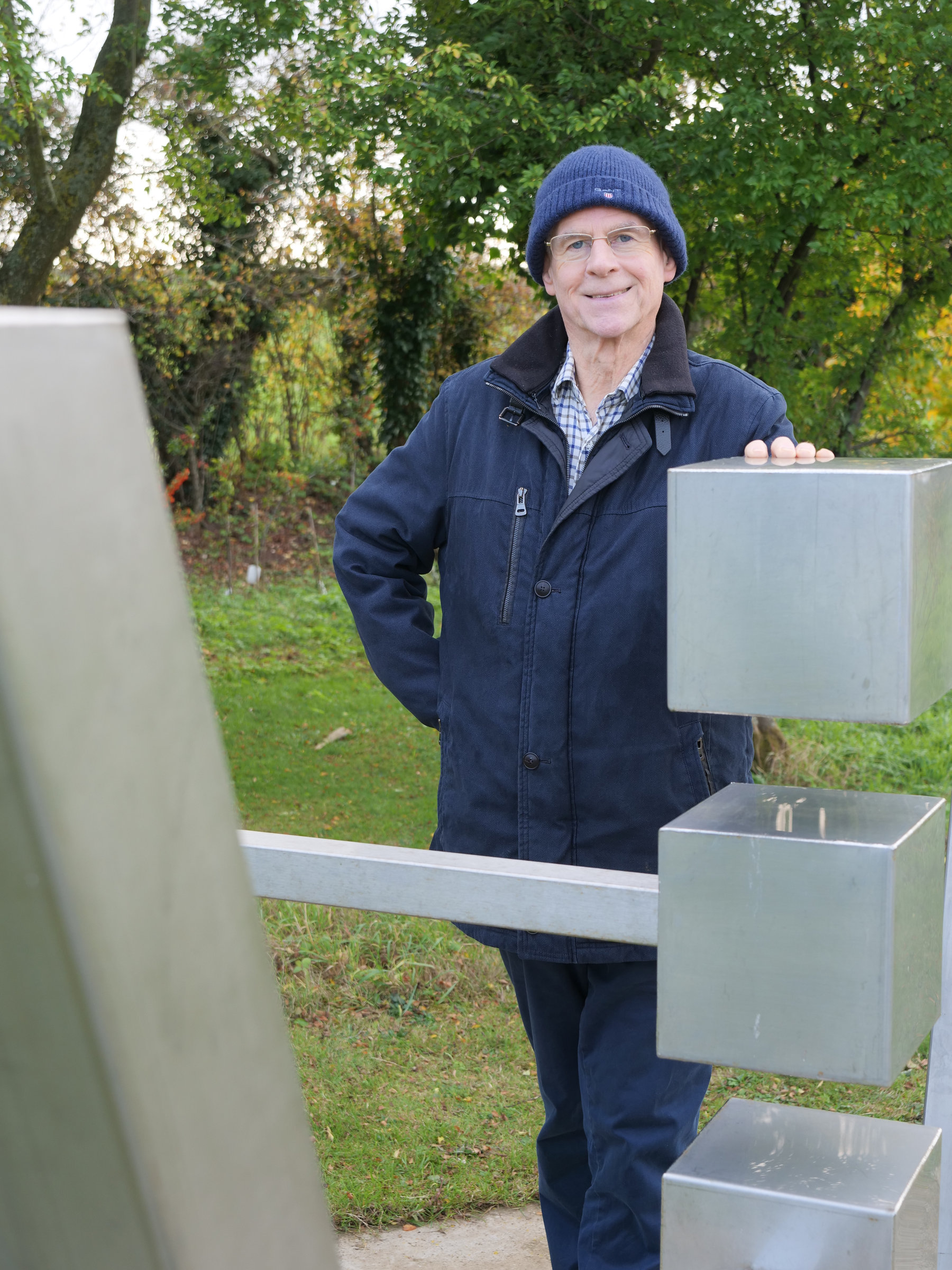
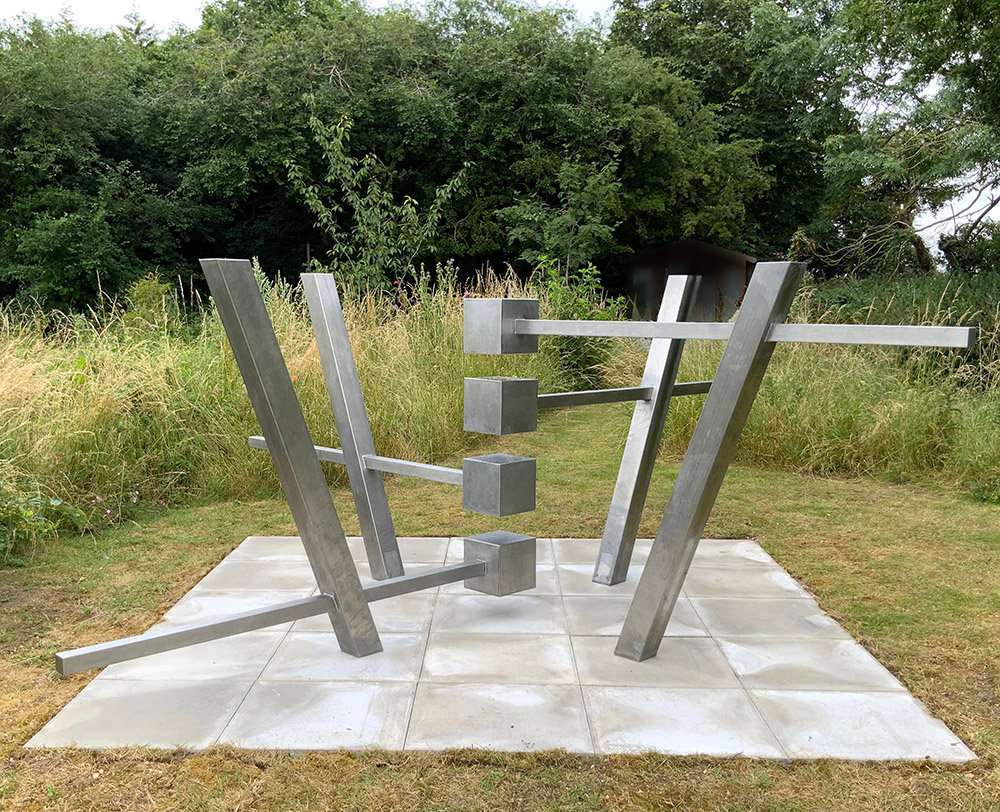
Suspense is the sculpture which incorporated these principles most successfully. Four cubes, held in a balanced position by cantilevered columns, appear to be suspended in space above one another. Each of the four box and support units are individually balanced. The horizontal supports form the shape of a spiral which seems to move around the central column of ‘floating’ boxes.
The scale of the piece was a major consideration for me as I wanted it to relate to my own size - my eye level is the same as the tops of the columns. The placement of my sculptures in an exhibition space is important but not as much as the internal relationships within the sculpture which for me are the main reason for the success of a work.
There’s something quietly uncompromising about your early decisions — turning away from traditional presentation, experimenting with light, form, and spatial interruption. Did you ever feel pressure to make the work more ‘accessible’ in those formative years?
I do like to think of my early sculptures as uncompromising - I was very much committed to abstraction and clear about my objectives. It was part of the Minimalist aesthetic where anything superfluous to the idea was excluded. I admired American sculptors like Donald Judd, Robert Morris, Carl Andre and David Smith - especially his more geometric Cubi series.
Having only recently started practising sculpture I was not encumbered by traditional notions of it and I felt that I was free to do whatever I wanted. It was liberating and exciting. I have never felt particularly comfortable in groups and although I had some close friends who were sculptors, I have always ploughed my own furrow. Although I sought advice from friends and tutors, I just wanted to try and be true to myself and my ideas.
While studying on the Post Graduate Advanced Course at Saint Martin’s School of Art in London, what made you change direction from sculpture back to painting?
If my initial experience of studying on the Fine Art B.A. Course at Newcastle University was perplexing, my experience of studying on the Post Graduate Advanced Sculpture Course at Saint Martin’s School of Art in London was traumatic. Although I had gained a B.A. First Class (hons) Degree at Newcastle, the sculpture I produced at Saint Martin’s was met with derision. The staff disapproved of my practice of making small maquettes as preparation for a sculpture as well my method of fabricating forms out of hardboard and wood. It was deemed ‘architectural’ and ‘remote’. I was told that my approach was wrong and that it wasn’t ‘sculptural’.
Ironically, I felt less freedom to explore my own sculptural path at Saint Martin’s than I did at Newcastle. It was an unhappy time for me and at the end of the first term I realised I had to make a decision about whether I wanted to continue on the course, and more importantly if I wanted to continue with sculpture.
I decided that perhaps I had got into it for the wrong reasons and I missed a lot about painting - using brushes, paint, colour – and, moreover, all the artists I most admired were painters. Saint Martin’s kindly allowed me to transfer to the Advanced Painting Course, which was less prescriptive, with a much more student centred approach, and I have never regretted my decision.
How did your new paintings at this stage differ from your earlier ones?
My new paintings differed from my previous ones in that they were abstract, not representational. I also changed the scale on which I worked: almost all of my previous paintings were on small, standard size canvases , often 20 x 24 inches, but my admiration for contemporary abstractionists encouraged me to work on a larger, often six-foot, scale. One of my reasons for going into sculpture had been that I felt painting was at a bit of a dead end.
I wasn’t interested in the then dominant movement of Pop Art; instead, the American Abstract Expressionist and Colour Field painters were my heroes. However, I couldn’t see how I could take what they had done any further. I was very impressed with my friend, Sean Scully’s (we were students together at Newcastle University) dynamic grid paintings, which were exhibited at the Rowan Gallery, and there was a ravishingly beautiful retrospective exhibition of Morris Louis’s Veil , Unfurleds and Stripe paintings at the Hayward Gallery in London.
I experimented with his process of staining thin acrylic paint directly into unprimed canvas and produced a number of works in this vein: Morning Light , 1977, and Pink and Green , 1979, are two examples.
Both paintings show bright and pure bands of colours which flow freely into each other creating very exciting and luminous, often soft, effects. They were achieved by thinning down acrylic paint with water and adding a few drops of water tension breaker liquid. In this way, the paint soaked directly into the canvas and became part of the fabric. In contrast, if you paint on a primed canvas, the film of paint always remains on the surface and is not absorbed into it.
In other pictures, I built up thick layers of acrylic paint using gels applied with trowels, blocks of wood, palette knives and my fingers, which provided textural interest to the surface, see my paintings Pink Stripes , 1978, Green Torrent , 1978, and Autumn , 1978.
I would sometimes sink a rectangular shape into the paint layer to provide a focal point within the all over field - as in Purple and Blue , 1978, below.
Because I found that acrylic paint was such a versatile medium, where you can stain or build up thick textures by adding gels to the paint, I have mainly worked with acrylic ever since. Its quick drying qualities and the fact that it is water-based also make it very practical to use.
What were your artistic concerns at this time? Were there any influences from your sculptural work carried over into your new abstract paintings?
When I looked through a large monograph on Hans Hofmann, the elder statesman of Abstract Expressionism, in a friend’s flat while I was still studying on the Sculpture Course at Saint Martin’s, I was captivated by what I saw. Bold, colourful, richly textured abstract paintings which radiated energy and positivity. The paintings which contrasted brightly coloured rectangles against loosely painted backgrounds particularly appealed to me - they seemed to have affinities with the Cubi series of sculptures by David Smith which had been an inspiration to me when I was sculpting. They felt very sculptural, possessing a physicality which is absent from the atmospheric, thinly painted floating rectangles of Mark Rothko and the flat, stained surfaces of Morris Louis and Kenneth Noland.
I had also seen the brightly coloured and thickly textured rectangle paintings of John Hoyland at the Tate Gallery in London, and they had left a profound impression on me. I resolved to create some paintings with these qualities in mind. Another important aspect of Hofmann’s and Hoyland’s work is that it feels ‘European’ because of the compositional balancing of shapes and colours in contrast to the Americans, who used simpler, ‘all over’ compositions.
Below you see the first of my paintings in this manner. In Colour Interaction, 1973 , a complex composition is built around several rectangles in harmonious colours. One aim of this picture was to make the colours shimmer and glow.
You’ve mentioned that your sculptures were “more intellectual than intuitive.” Do you think that purity — that instinctive drive — has been difficult to preserve as your career has developed?
I think all art has to maintain a balance between the intellectual and emotional. If it becomes too intellectual it can seem cold and academic; if it is too emotional it can become incoherent and lacking in structure. Goya made a famous etching titled The Sleep of Reason Produces Monsters , in which a sleeping man is plagued by horrible monsters in his nightmares. When I was making sculpture, I consciously concentrated on rationality - I created rules which I adhered to and everything had to be justified. Looking back, it was too restrictive in order for me to carry on in this mode because I was then craving again more room for improvisation.
When I returned to painting, I reacted very strongly against the dominance of order in my art and it became freer and more expressionistic. I now try to maintain a balance between the two extremes. When I paint, I work quite fast; I have to trust my decisions as I make them and get the whole painting down in one go. If I keep pausing and thinking about the painting too much, I lose the momentum and the painting doesn’t flow. It’s a fine balance of thought and action. It’s important to keep the spark that got me painting in the first place. If you get bogged down with theories, art can become a chore and you can lose the excitement and motivation to do it. Instead, I very much enjoy the process of painting; there is always the hope that my next painting will be my best ever! Pink Cloud , 2023, is a more recent work which demonstrates my urge to keep experimenting as an artist.
Were there any artists, living or dead, that you were secretly in conversation with during your early years — not just as influences, but as internal points of tension or competition?
In 1967, my paintings were exclusively representational consisting of portraits, landscapes and still lifes. The portraits were influenced by Rembrandt and Cezanne (see below: Self Portrait, 1967, and The Artist’s Mother , 1967).
I used to regularly visit the Fitzwilliam Museum in Cambridge, where there was a very striking painting, Portrait of a Man in Military Costume , 1650, by Rembrandt, and I marvelled at the dramatic light effect and the use of chiaroscuro (strong light – dark contrast) and impasto. The self-portrait I painted, above, was strongly influenced by Rembrandt.
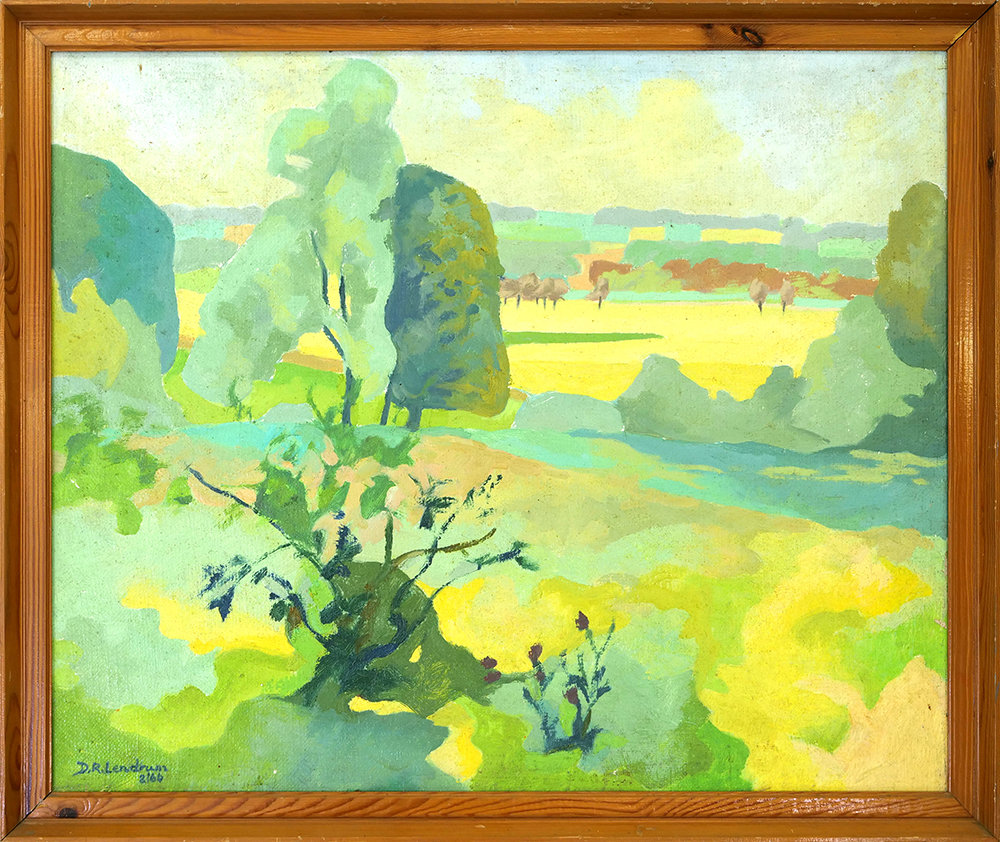
Whenever I got the opportunity, I would take the train to London and visit the National Gallery, the Tate Gallery and the Courtauld Institute Gallery which has a fabulous collection of the Impressionists. The landscapes and still lifes of Cézanne and Monet particularly impressed me, and I adapted their way of applying paint and colour to my own work, as can be seen in my paintings, Under the Beech Tree , 1963, Ringstead from the Top of Peddars Way , 1966, and Still Life of Flowers with Three Vases , 1966, all below.
By 1971, my art was completely different, comprising of resolutely abstract sculptures; austere and minimal, freely standing on the floor. As well as the American Minimalists like Judd and Morris, I had also discovered the work of the British sculptors Sir Anthony Caro and Philip King. The balancing quality of the superb sculpture by Sir Anthony Caro titled Prairie , 1967, was something I wanted to emulate in a different way in my own work, titled Suspense .
If you could walk into one of your earliest exhibitions anonymously today, what do you think would surprise you most about the work — or your younger self?
Looking back at my early exhibitions and I am thinking of one in 1967, I am aware how much my work has changed and how many different styles, media and materials I have used. I would hardly recognise some of the paintings as mine now. But fundamentally I do believe every artist has their own unique personality which determines the use of colour, brushmarks, textures and composition that you find in every work of their art. Some of my early works were quite muted in colour; I enjoyed painting fog and mist, as in can be seen in the painting, View of Hail Weston , 1965, below, and I worked a lot in soft pastel, a medium I still enjoy using today. Included here is an example of a soft pastel drawing of a Copper Beech Tree which I did in1967.
When I was young, I never adopted a particular method of working or style but tried to record the magic of the scene in front of me. Every artist goes through an evolution of ideas and styles, and there have been so many radically new art movements to choose from during the last one hundred years. Navigating my way through these turbulent waters, I have retained my own voice, all the time attempting to improve my work and produce better art in whatever manner I have utilized.
David Lendrum’s career reveals an artist who refuses to be confined by expectation or medium. His early fascination with the physicality of sculpture gave way to a renewed passion for painting, where colour and emotion became his primary architecture. Decades on, his work continues to bridge rational thought with spontaneous expression, never losing the immediacy that first drew him to art. Looking back, Lendrum sees each era of his work not as a departure but as part of a single unfolding dialogue — one that still asks how art can balance freedom with form, and reason with imagination.
Credits: The sculpture Suspense was fabricated in stainless steel in 2021 from the original plywood sculpture in the size 1:1 by Catton’s Fabrications, King’s Lynn, UK.
Photographs: Helga Joergens, © 2025 David Lendrum
Continue Reading
More Art & Design
Joan Eardley’s North Sea Paintings Still Feel Wild Enough To Blow You Over
Mat Collishaw’s Death Row Paintings Turn America’s Final Meals Into Modern Vanitas
Constable’s Suffolk Returns Home As The Hay Wain Travels East
Why Art Basel Is Turning To Trees In Search Of Calm

Stories worth your
weekend.
A handpicked dispatch from Hinton's editors. The long reads, the people, the openings, the things worth knowing. No filler.