_edited.jpg)
Inside Moldova’s Hobbit Houses Redefining Sustainable Escapes
- Hinton Magazine

- Aug 26, 2025
- 3 min read
Updated: Nov 26, 2025
On the quiet banks of a forgotten lake near the village of Panăşești, just twenty minutes outside Chişinău, three small mounds rise from the earth. At first glance, they might be mistaken for natural formations — humps of grass that have always been there. Step closer, though, and the details reveal themselves: curved glazing that frames the water’s surface, handcrafted interiors alive with timber and clay, and a certain mythical charm that feels plucked straight from the pages of Tolkien.
This is Hobbit Wake Houses, a new project by Moldova’s leading practice LH47 ARCH. Nestled into the landscape of the country’s first wake park, the cabins are a study in how design can disappear into its surroundings while quietly rewriting ideas of sustainable living.
Each cabin is partly submerged, crowned with a green roof that gradually blurs the boundary between built form and soil. It’s an architectural gesture that goes beyond aesthetics. Earth-sheltering improves thermal stability, reduces energy waste, and restores visual continuity to the landscape. In essence, the cabins return what they borrow.
The materials continue this philosophy. Instead of synthetic insulation, the walls are thick with straw bales — a rural technique once commonplace in Moldovan villages, now revived here with contemporary precision. Finished with clay-and-straw plaster and lime wash, the result is a breathable, self-regulating skin. Inside, the air seems to balance itself: cool and dry in summer, warm and steady in winter.

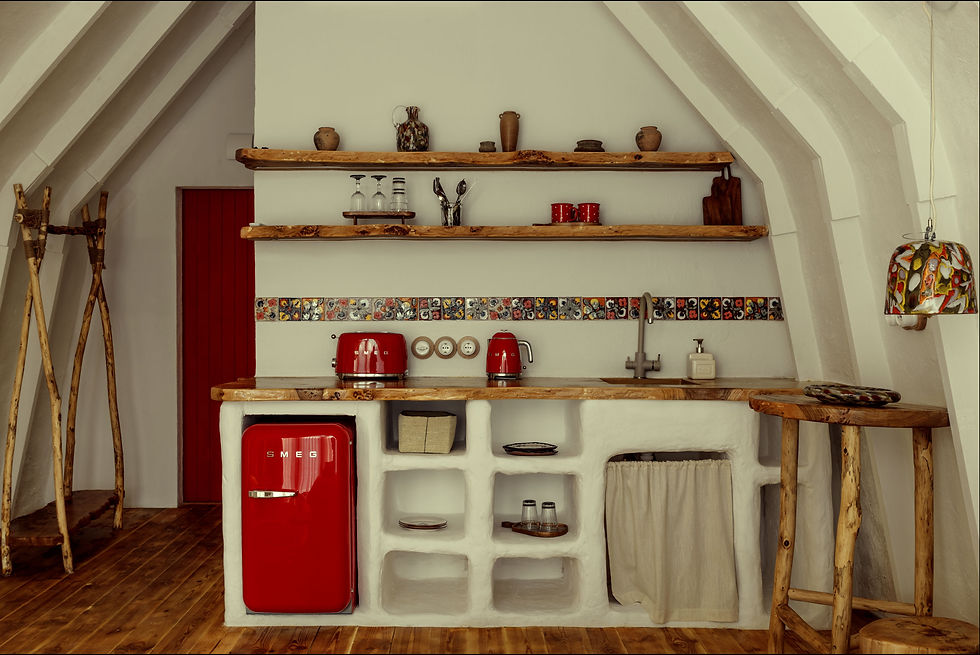
If the exterior reads as landscape, the interiors reveal the hand of the maker. Beds, kitchens and joinery have been shaped by Lemnaria, a local workshop, with each cabin carrying subtle variations in shelving, mirrors, or table forms. Ceramic artist Eugenia Burlacenco’s bespoke lighting lends a gentle glow, almost ritual in its warmth. It’s this individual touch — a mirror slightly different in one cabin, a shelf arrangement unique to another — that recalls the improvisational spirit of vernacular craft, where no two pieces were ever alike.
For Serghei Mirza, founder of LH47, the project is both an experiment and a statement. Building with clay, straw, timber and soil required a relearning of techniques long abandoned in the pursuit of modernity. The green roofs demanded innovation too, with the studio designing special mesh systems to keep the soil in place until grasses root and reclaim the surface. The result is architecture that almost disappears — structures that feel protective and intimate, yet open to nature.

More than a retreat, Hobbit Wake Houses stand as a reminder of another possible rhythm of life. A model where low-tech building methods, heritage craft and ecological principles converge to offer something far richer than conventional holiday cabins.
For travellers, the appeal lies not just in their Tolkien-esque charm but in what they represent: an escape that feels both elemental and modern, deeply local yet universally resonant. Waking in a Hobbit House is to wake inside the land itself, cradled by soil and straw, looking out through sweeping glass to the stillness of water.
In Moldova — a country often overlooked on the design map — Hobbit Wake Houses are a bold and beautiful statement. They show that sustainability doesn’t need to be high-tech or sterile; it can be earthy, tactile, and rooted in culture. For those who seek escapes with soul, this lakeside trio offers exactly that.


Comments