_edited.jpg)
Lu Yang Turns the Louis Vuitton Espace in Venice Into a Digital Temple of Identity, Illusion, and Reincarnation
- Hinton Magazine

- 10 minutes ago
- 3 min read
As Venice once again becomes the centre of the contemporary art world during the Venice Biennale, luxury houses continue expanding their presence far beyond sponsorship and branding. Increasingly, they are positioning themselves as active cultural institutions, shaping not only where art is shown, but how it is contextualised globally.
The latest example comes from Louis Vuitton, whose Venice space presents DOKU The Illusion, a major solo exhibition by Lu Yang. Staged as part of the Fondation Louis Vuitton’s Hors-les-murs programme, the exhibition marks both the twentieth anniversary of the Espaces Louis Vuitton initiative and a decade of the foundation’s international exhibition strategy. Yet beyond institutional milestones, the project signals something more significant about where contemporary art itself is moving.
Lu Yang’s work has consistently occupied a space between digital mythology, philosophy, gaming culture, and speculative identity. Their practice is often visually overwhelming, pulling from manga, anime, artificial intelligence, gaming aesthetics, and post internet culture. However, reducing the work to its surface references misses its deeper structure. Beneath the hyper digital imagery lies an ongoing philosophical enquiry into consciousness, illusion, mortality, and what remains of the human subject once identity becomes infinitely reproducible.
That enquiry sits at the centre of DOKU The Illusion.
The exhibition revolves around DOKU, the artist’s recurring digital avatar constructed from a scan of Lu Yang’s own face. Existing somewhere between alter ego, virtual deity, and posthuman protagonist, DOKU functions as a vehicle through which the artist explores digital reincarnation, the possibility that identity itself can become detached from the limitations of the physical body.
In Venice, that concept takes on a particularly resonant form.
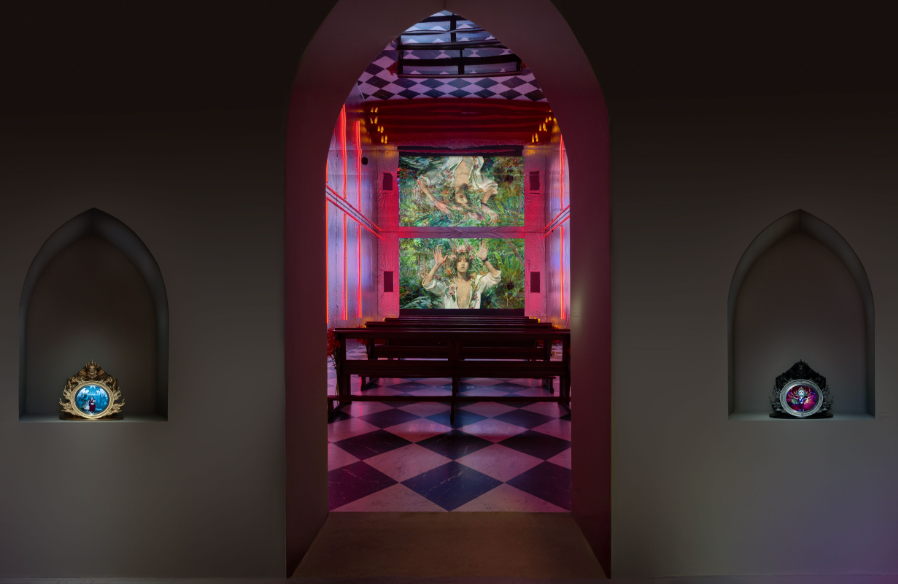
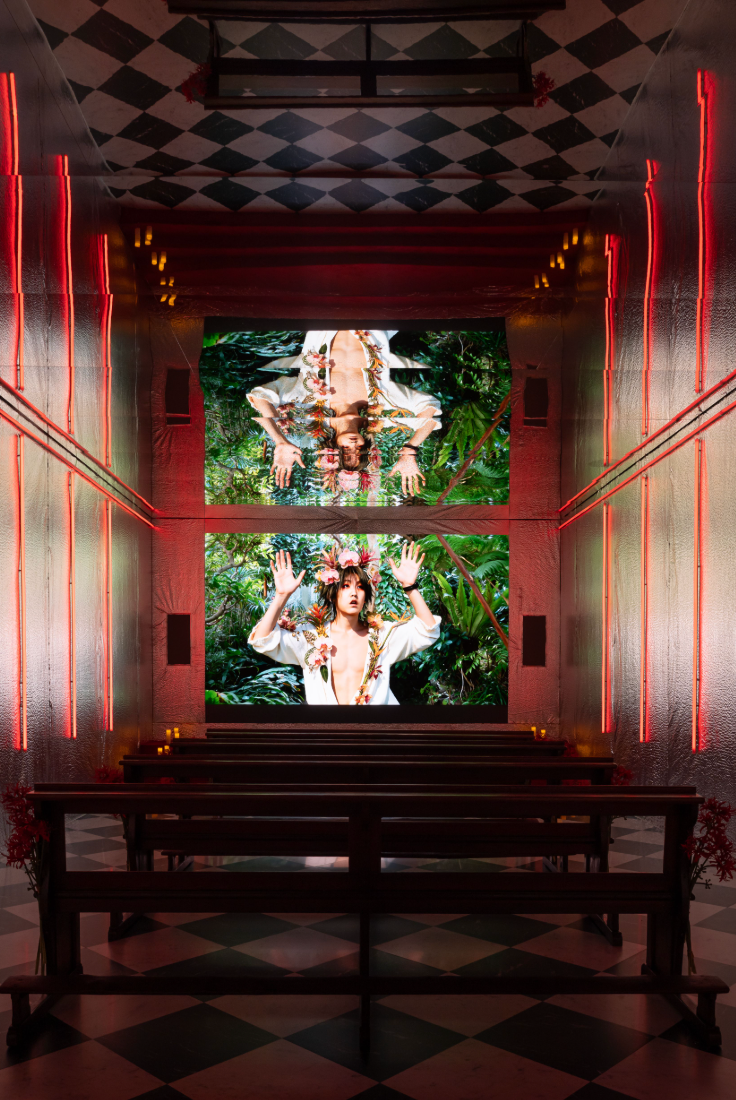
The installation transforms the Espace Louis Vuitton Venezia into what can best be described as a cybernetic sanctuary, a space suspended between sacred architecture and speculative future. At its centre sits a monumental LED screen displaying the latest chapter in the DOKU narrative, while mirrored surfaces and sculptural elements dissolve the line between spectator and artwork itself. Visitors do not simply observe the installation. They become absorbed into its visual system, their reflections integrated into an environment built around instability, repetition, and transformation.
The decision to frame the exhibition around Buddhist philosophy is equally important.
While Lu Yang’s work is often associated with contemporary digital culture, its intellectual foundation lies heavily within Buddhist thought, particularly ideas surrounding illusion, awakening, cyclical existence, and the instability of fixed identity. The mirrored ceilings, Buddha sculptures, and recurring wheel of life motifs reinforce this, positioning the installation not merely as immersive spectacle, but as a meditation on impermanence in an age increasingly defined by digital simulation.
This tension between spirituality and technology is where the exhibition becomes most compelling.

Rather than presenting digital culture as detached from older systems of belief, Lu Yang treats technology as a continuation of humanity’s long standing obsession with transcendence. Artificial intelligence, avatars, virtual environments, and digital duplication become contemporary tools for ancient philosophical questions surrounding consciousness, mortality, and selfhood.
The Venice setting amplifies that further.
A city suspended between beauty and collapse, permanence and decay, feels uniquely suited to Lu Yang’s world of shifting realities and unstable identities. Within the broader context of the Biennale’s In Minor Keys theme, DOKU The Illusion operates as both visual experience and existential proposition, asking what it means to remain human in an era where identity can increasingly be simulated, replicated, and endlessly reconstructed.
Importantly, the exhibition also reinforces the changing relationship between luxury and cultural production.
Louis Vuitton’s role here is not decorative. Through the Hors-les-murs programme, the brand continues positioning itself as a serious participant within global contemporary art discourse, using its spaces not simply for visibility, but for institution level programming that engages directly with the wider conversations shaping international art today.
Ultimately, DOKU The Illusion is not interested in offering clean answers.
It constructs a world where spirituality, artificial intelligence, gaming culture, philosophy, and performance collapse into one another, forcing visitors to confront a question that increasingly defines the digital age itself.
If identity can endlessly evolve, duplicate, and dissolve, what exactly remains real?


Comments