_edited.jpg)
Sir John Soane’s Museum Explores the Surreal World of Madelon Vriesendorp
- Hinton Magazine

- 7 hours ago
- 3 min read
This summer, Sir John Soane's Museum will stage a major retrospective dedicated to Madelon Vriesendorp, offering one of the most substantial examinations yet of an artist whose influence on architecture and visual culture has often operated just outside the mainstream spotlight.
Titled Mind Games, the exhibition brings together more than fifty works spanning drawings, etchings, sculptures, collected objects, jewellery, and new works on paper, tracing a practice built around humour, surrealism, psychological play, and the transformation of ordinary materials into unexpected forms of meaning.
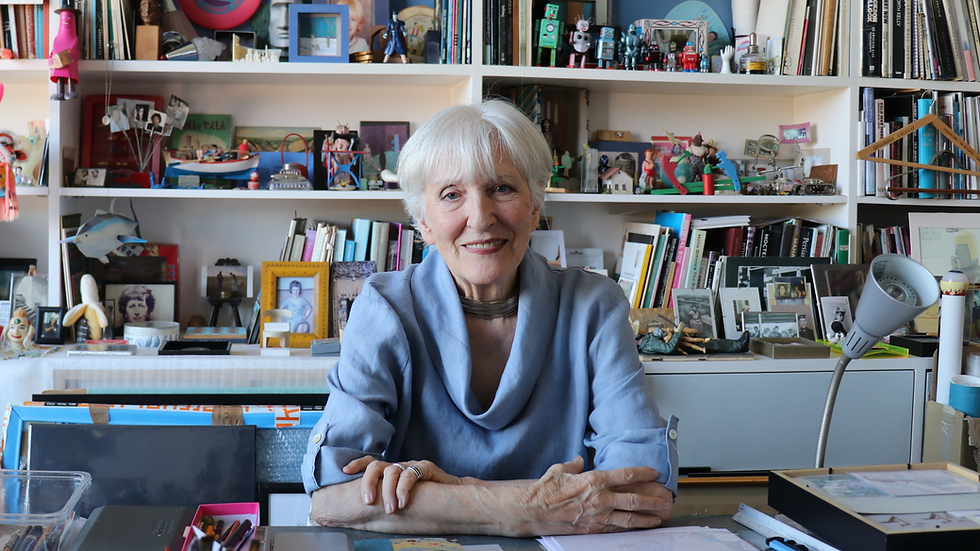
Vriesendorp occupies a singular position within postwar visual culture.
While many know her through her association with Office for Metropolitan Architecture, which she co founded alongside Rem Koolhaas and Elia and Zoe Zenghelis in the early 1970s, her work has always existed beyond architecture itself. Her drawings and paintings helped define the visual identity surrounding OMA’s early theoretical projects, particularly during a period when architecture was becoming increasingly conceptual and speculative.
Yet what makes Vriesendorp’s work enduring is not simply its relationship to architecture, but its refusal to remain constrained by it.
Her practice consistently blurs the line between fine art, object making, psychological experiment, and visual joke. Buildings become characters. Everyday objects become diagnostic tools. Toys, postcards, plastic bottles, eggs, and found materials are elevated into systems of narrative and symbolism that feel simultaneously absurd and intellectually precise.
That tension sits at the heart of Mind Games.

The exhibition’s centrepiece is a large scale version of Vriesendorp’s celebrated Critical Pursuit Home Analysis Kit, more commonly known as the Mind Game. Part psychoanalytic exercise and part surreal board game, the work invites participants to arrange a collection of miniature objects into improvised tableaus that are then interpreted psychologically according to meanings assigned by the artist herself.
The work functions simultaneously as sculpture, theatre, game, and critique, exploring how people project identity, memory, and subconscious behaviour onto seemingly meaningless arrangements of objects. In many ways, it encapsulates the logic underpinning Vriesendorp’s wider practice, where humour becomes a serious tool for destabilising how viewers interpret the world around them.
That sensibility extends throughout the exhibition.
Recent sculptural works from the Plastic Surgery series transform discarded packaging into surreal anthropomorphic forms, including swans constructed from milk bottles and figures assembled from cleaning product containers. Elsewhere, eggs become political dictators, everyday materials are stripped from their original purpose, and visual logic is deliberately interrupted in ways that force viewers to reassess the symbolic potential of ordinary things.
The result is an exhibition deeply rooted in play, though never superficially so.
Vriesendorp’s work consistently uses humour as a destabilising force. Objects shift meaning depending on context, scale, arrangement, or viewer interpretation. Serious ideas are approached through wit, while seemingly playful gestures reveal surprisingly sharp commentary beneath the surface.

That relationship between architecture, psychology, and surrealism feels particularly relevant within the setting of Sir John Soane’s Museum itself.
Like Vriesendorp, John Soane approached collecting and display as acts of imagination rather than strict categorisation. The museum’s dense arrangement of artefacts, fragments, models, and visual references creates an environment where objects accumulate meaning through juxtaposition and association. In that sense, Mind Games feels less like an external exhibition placed inside the museum and more like an extension of Soane’s own philosophy of curiosity and spatial storytelling.
Importantly, the retrospective also reflects a broader reassessment currently taking place around Vriesendorp’s contribution to contemporary architecture and design culture.
For decades, her work circulated alongside architectural theory while often being framed as supplementary to it. Increasingly, however, critics and curators are recognising that her visual language helped shape how generations understood postmodern and conceptual architecture itself. Her images did not simply illustrate ideas. They gave them emotional, surreal, and psychological form.
As recipient of the 2025 Soane Medal, Vriesendorp becomes the first UK based female practitioner to receive the award since its inception, a recognition that feels overdue given the depth of her influence across art, architecture, and visual thought.
Ultimately, Mind Games is not a retrospective built around chronology or career summary alone. It is an invitation into a way of seeing, one where humour, play, and imagination become serious intellectual tools capable of reshaping how we understand both objects and ourselves.


Comments