_edited.jpg)
UK Retail Sales Rise In Q1, But Growth Remains Selective
- Hinton Magazine

- 24 minutes ago
- 2 min read
Britain’s retail sector delivered stronger than expected first quarter growth, but beneath the headline numbers, the latest data from the Office for National Statistics points less to consumer confidence than to a more tactical, pressure shaped spending environment. According to the ONS Retail Sales statistical bulletin released on 24 April, retail sales volumes rose 1.6 per cent in Quarter 1 2026 compared with the previous quarter, while March alone saw a 0.7 per cent monthly increase following February’s decline.

The topline suggests resilience. The detail suggests caution.
A significant proportion of March’s uplift came from fuel, where volumes rose sharply as motorists responded to rising prices amid Middle East instability. Strip out automotive fuel, and monthly growth falls back to 0.2 per cent. In practical terms, this was not a broad consumer surge, but a market reacting to immediate cost pressures.
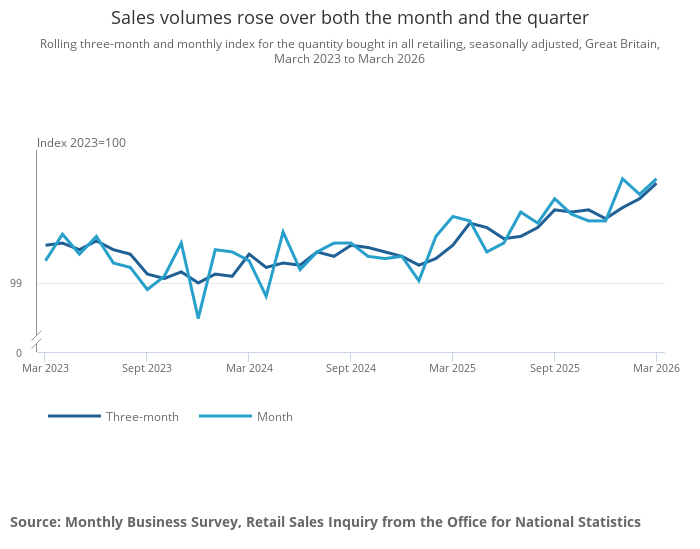
Elsewhere, growth was selective rather than universal. Clothing retailers benefited from improved weather, cosmetics and toiletries were supported by new collection launches, and non store retail, largely online, continued to outperform through spring promotions and product drops. Online spending values rose 2.5 per cent over the quarter and 11.7 per cent year on year, reinforcing the structural shift toward digital channels.
For business leaders, the wider takeaway is increasingly familiar. Consumers are still active, but they are spending with precision. Essentials, seasonal purchasing, and category specific launches are driving movement more than broad based optimism.
This creates a more demanding retail environment. Revenue opportunities remain, but they depend more heavily on pricing discipline, inventory timing, category strategy, and data led execution than on any sustained uplift in household confidence.
Melissa Minkow, Director of Retail Strategy at CI&T, puts it directly:
“The BRC data shows that economic sentiment is no longer a reliable correlate to spend. Shoppers are pre-empting an increase in bills and spending, predominantly triggered by macro-economic factors and the resulting volatility.
This moment is a key example of how retailers and consumers are on the same team. Retailers should always use real-time data to provide the best prices to consumers while maintaining profitability, but this ability is especially crucial during these uncertain times.”
That distinction matters.
Retail is not weakening, but nor is it accelerating through confidence. Instead, it is adapting around inflationary pressure, geopolitical disruption, and increasingly selective consumer priorities.
For policymakers, this is a reminder that consumer spending has not detached from economic anxiety. For retailers, it is a warning that demand remains present, but fragile.
Growth is there.
But in Britain’s current consumer economy, growth without confidence is a very different proposition.
For the full ONS statistical bulletin, see Retail sales, Great Britain: March 2026.


Comments