_edited.jpg)
Leigh Witherell: Painting the Quiet Conversations of the Human Soul
- Hinton Magazine

- Jan 30
- 7 min read
In a world of art that often demands attention through spectacle, Leigh Witherell’s work quietly insists that we pause, look closer, and feel. Based in Philadelphia, Pennsylvania, Witherell is a contemporary figurative artist whose canvases capture the unspoken, the intimate, and the profoundly human. Her acrylic compositions traverse vulnerability, grief, love, and introspection, inviting the viewer into moments they might otherwise overlook. From fine art nudes that celebrate raw vulnerability to emotionally charged narratives exploring the spectrum of human experience, Witherell’s work is as much about conversation as it is about form. Her exhibitions have spanned continents, from the streets of Madrid to the digital heart of Times Square, proving that emotion is, ultimately, universal. In this candid interview, she opens up about the personal tragedies that reshaped her art, the philosophy behind her evocative compositions, and her unflinching approach to portraying the truths we all live with yet rarely speak of.

Leigh, your work often captures deeply intimate moments and human emotion. Can you take us back to the experiences or influences in your early life that first drew you to explore these themes in your art?
I come from a family of storytellers. Every family event was filled with stories from everyday life and that is how we communicated. What that teaches is that our life isn’t about what the public sees, it is about what we say in our stories that tells the world about who we are and what we find important. It is that area between the lines of what we see and what we say where life is lived. My art is having a quiet conversation with the observer about this space, quietly bringing into focus those hard emotions and situations that we find hard to talk about and try to hide from the world. These are the things that being raised in a family of storytellers taught me to pay attention to because these are the things that make us human.
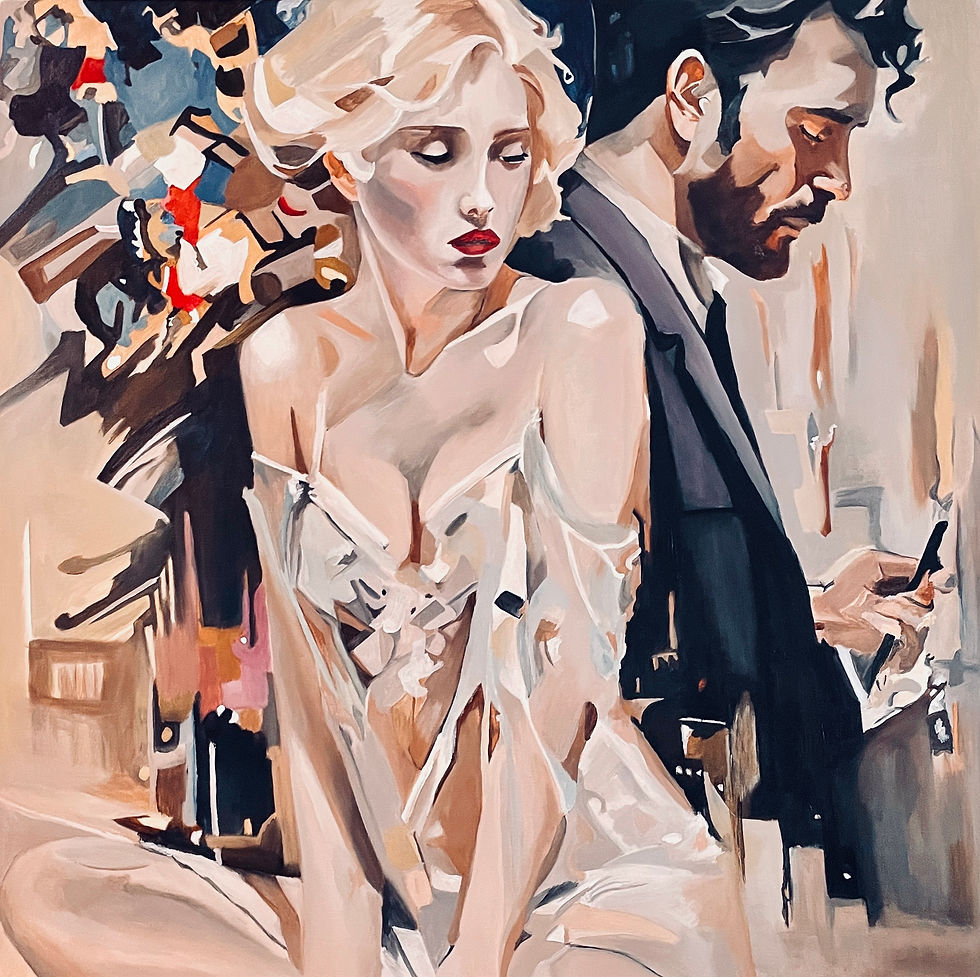
Your artistic journey has included both fine art nudes and emotionally driven figurative works. How do you balance the physical and emotional aspects of your subjects when you create, and what do you hope viewers take away from these pieces?
To me, the physical and emotional aspects of my art are the same, I don’t separate them. I feel that if I try to separate these two things, my art becomes clinical and sterile. I’m afraid that I would lose the very thing that makes my art unique, that connection between the physical and the emotional. I love to paint nudes simply because I believe that when we have no physical barriers (like clothing) we are our most vulnerable. These figures are quietly placing themselves in the position to be judged by the world in the hope that connection with viewers will be an intimate journey filled with understanding and empathy. I hope that viewers walk away feeling that connection and the impact it has on the mind, body, and heart.

The personal tragedy you experienced in 2021 appears to have profoundly shaped your work. How did this event influence your artistic philosophy, and how has it transformed the way you approach your craft?
Before my daughter died I feel that I lacked authenticity in my art. Every composition had this feeling of beauty and enthusiasm for life that failed to look at the full range of emotions in life. I was ignoring anything ugly or intense to fit a narrative that wasn’t mine. My work has a sense of longing in it that cannot be hidden. Because of my own personal experience, that longing is for a life that should have been. But longing isn’t about just one thing, so for the observer that longing can be about a myriad of different things. I also feel that since her death I no longer have the inclination nor the time to hide emotions and try to fit in with what others would deem beautiful or peaceful. This longing brings an authenticity to my work where I can process not only my own emotions as they are at that time but also process past emotions that inhibited my creativity in a way that stunted my growth as an artist. Her death changed my approach to my craft in that I am no longer willing to allow other’s input on what I should be painting guide my journey. In short, I no longer care if someone thinks it’s beautiful, I only care that it’s talking.

Your exhibitions span the United States, Europe, and even digital spaces like Times Square. How does showing your work across different cultures and contexts influence the way you think about the universality of human emotion?
The biggest benefit in exhibiting across a wide section of cultures and mediums is that it brings an understanding that we are all humans and we all have emotions, life, experiences, and value. It shows me as an artist that my work resonates on a universal scale simply because it shows that humanity is a universal thing. My hope is that by varying the mediums my work is exhibited in I can reach a broad range of ages in art lovers.
Your palette and brushwork are often described as organic and evocative. Can you describe your process in choosing colours, textures, and composition to convey particular feelings or narratives in a piece?
Truthfully, I tend not to think about what a color or a texture will convey in a composition. My color palette tends towards earthy colors that invoke a calm beauty simply because these are the colors I choose in my real life. I want my figures to stand out for their emotional quality on their own, I never want to drag a viewer into the scene by manipulating them with colors. My bold brushstrokes are quite simply what feels right to me. I don’t get all that caught up in tiny details, I’m more about the big impacts. My goal is to show that these emotions are from our everyday lives no matter what our lives look like to the outside world

Many of your works focus on relationships, grief, and introspection. In your opinion, what role does contemporary figurative art play in helping society reflect on and navigate human emotion today?
In my opinion, figurative art allows the viewer to immerse themselves in the composition in a way that is unlike any other style of art. I love to see a viewer become mesmerized by an artwork I have created. It tells me that the art is having that quiet conversation with the viewer that I want. I don’t get to choose the words or the relationship between that viewer and the art and that is my whole point. Figurative art can allow the viewer to see their own emotions and experiences.
Your residencies, such as at Buinho Creative Hub in Portugal, provide dedicated time and space for creation. How have these experiences shaped your practice, and what insights or breakthroughs have emerged during these periods?
The residency I did in Portugal was integral in allowing me to see the importance of getting out of my safe space and exploring new experiences. The village of Messejana was so welcoming and the people were so amazing that it was easy to create freely and without distraction. There were other amazing artists there and having their input was so valuable. Sometimes you need to get out of your space to be able to get out of your head.

Your collectors often speak of the personal resonance and emotional connection your work brings into their homes. How do these responses shape your understanding of the impact of your art, and does it influence your future creations?
I love my collectors! They choose pieces that speak to them. They aren’t just buying a pretty piece for above the couch; they are bringing a piece home that is speaking to their hearts. I am still awed at the fact that anyone would want to bring my work into their home. It makes me grateful and appreciative to know that I can impact lives by making these evocative compositions. I see my art becoming even more daring in its emotional composition in the future. We’ll see how that goes!

Looking ahead, how do you envision the evolution of your work over the next decade? Are there new themes, techniques, or collaborations you are eager to explore that continue your dialogue with culture, emotion, and human experience?
I see my work evolving to include more social commentary and more controversial emotions and situations as I evolve as an artist. I really don’t set any themes to my work, it’s just what catches my attention at the moment. I would love to show in many exhibitions and have some more solo shows as well, so I guess we shall see.

Leigh Witherell’s art explores the spaces between visibility and expression, the quiet intervals where human emotion resides. She reflects on a life shaped by storytellers, personal loss, and the courage to embrace authenticity, revealing how each experience feeds into her evocative figurative work. Witherell discusses the inseparable bond between the physical and emotional in her art, the universality of human feeling across cultures, and the role contemporary figurative painting plays in guiding viewers to confront and connect with their own emotions. From residencies in Portugal to a growing global collector base, Witherell’s journey is one of daring honesty, cultural resonance, and a commitment to creating art that speaks to both heart and mind.


Comments